


CES Insights: Three in four Romanians stop treatment early, in the EU country with the highest treatable mortality
A recent BUCHAREST CENTER FOR ECONOMY & SOCIETY (CES Bucharest) survey, conducted for the #UndeDoare platform, provides insight into how Romanians manage symptoms, communicate with doctors and follow prescribed treatments.
Only 23% of respondents always complete their prescribed treatment, while three in four say they have stopped a treatment early at least once. The most frequently cited reason is feeling better (34%), followed by forgetting or simply not continuing (21%), cost (13%) and fear of side effects (7%).
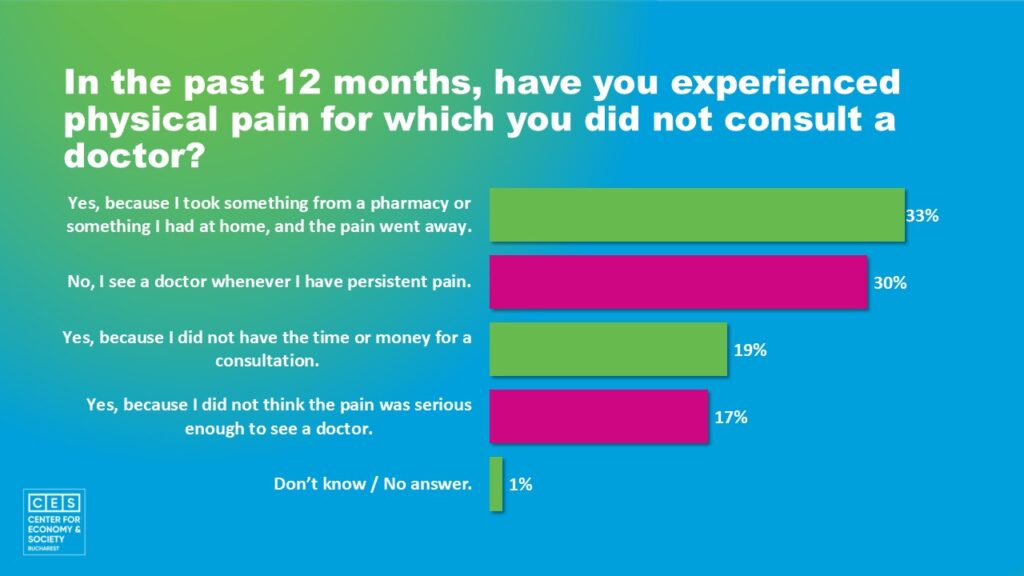
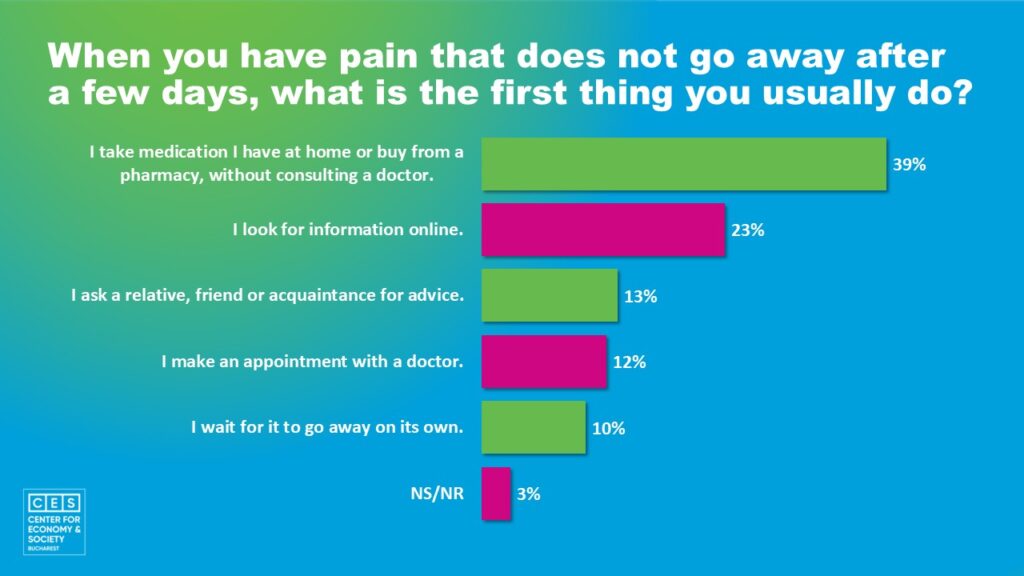
Engagement with the healthcare system before treatment begins reflects a similar pattern. Only 13% of respondents discuss persistent or recurring symptoms with their doctor, while 34% currently experience pain or discomfort they have never mentioned to a doctor, believing it is not serious. A further 20% know they should seek care but keep postponing it, and 14% say they will probably never do so. When pain lasts for several days, 39% turn to self-medication, 23% search for information online and only 12% book an appointment. A lack of time or money prevented 19% from seeing a doctor about persistent pain in the past year.
Explore CES Health events:
CES Health: Applied Multi-Stakeholder Dialogue – My e-Health National Digital Platform
CES National Public Health Conference
CES National Health Conference: Sustainable Financing, Innovation and System Resilience
Health literacy emerges as a further constraint. 58% of respondents say they often or very often hear medical terms they do not understand in conversations with doctors or pharmacists. At their most recent consultation involving a diagnosis, only 34% fully understood the diagnosis and the explanations provided, while 22% did not understand them well but did not ask for clarification.
These behaviours take on particular significance in the broader health context. Romania recorded the highest treatable mortality rate in the European Union in 2023: around 200 deaths per 100,000 inhabitants under the age of 75, 2.3 times the EU average of 86.8 (Eurostat). According to State of Health in the EU: Romania 2025 (OECD and European Commission), the widest gaps relative to the EU average concern hypertension and pneumonia, for which treatable mortality is almost six times the EU average. Hypertension can be detected through a simple blood pressure measurement and treated with long-established medicines.
The financial dimension also plays a role. Public insurance covers only half the cost of medicines dispensed in pharmacies, and medicines account for almost 60% of Romanians’ out-of-pocket health spending.
The survey was conducted by CURS (Center for Urban and Regional Sociology) for CES Bucharest in mid-2026 among the adult resident population of Romania, through face-to-face interviews at respondents’ homes. The probabilistic, multistage, stratified sample of 1,067 respondents was validated against the latest data from the National Institute of Statistics.
Through #UndeDoare, CES Bucharest brings these issues into public discussion, connecting research and accessible medical information with dialogue on sustainable solutions for Romania’s healthcare system.
Become a CES Bucharest member
A better future is everyone’s business. Be part of that change!
or call +40 723 260 790
MY CES
Subscribe to CES Newsleeter to receive research news & updates
By clicking ‘Subscribe’ you agree to our Terms of Use . For further information about how the CES Bucharest processes your personal data, please click on our Privacy Policy .